
Race preparation
HYROX training
Measure each station once and WODR projects your finish from your own numbers, then builds the sessions that close the biggest gaps.
The race plan
Three stages,
run in order.
HYROX preparation in WODR starts from a measured baseline rather than a generic plan. Each session after that is aimed at a specific gap in your projected finish.
Set a baseline
One measured effort per station, at race volume and race weight. No sled at your gym? The baseline adapts to the kit you own rather than locking you out of it.
Read the projection
Eight station legs, eight runs and the roxzone, each built from your own splits. Work done on a stand-in movement counts towards the leg in proportion to how close the stimulus is, so it moves the projection without ever claiming a time you did not set on the station.
Work the pathway
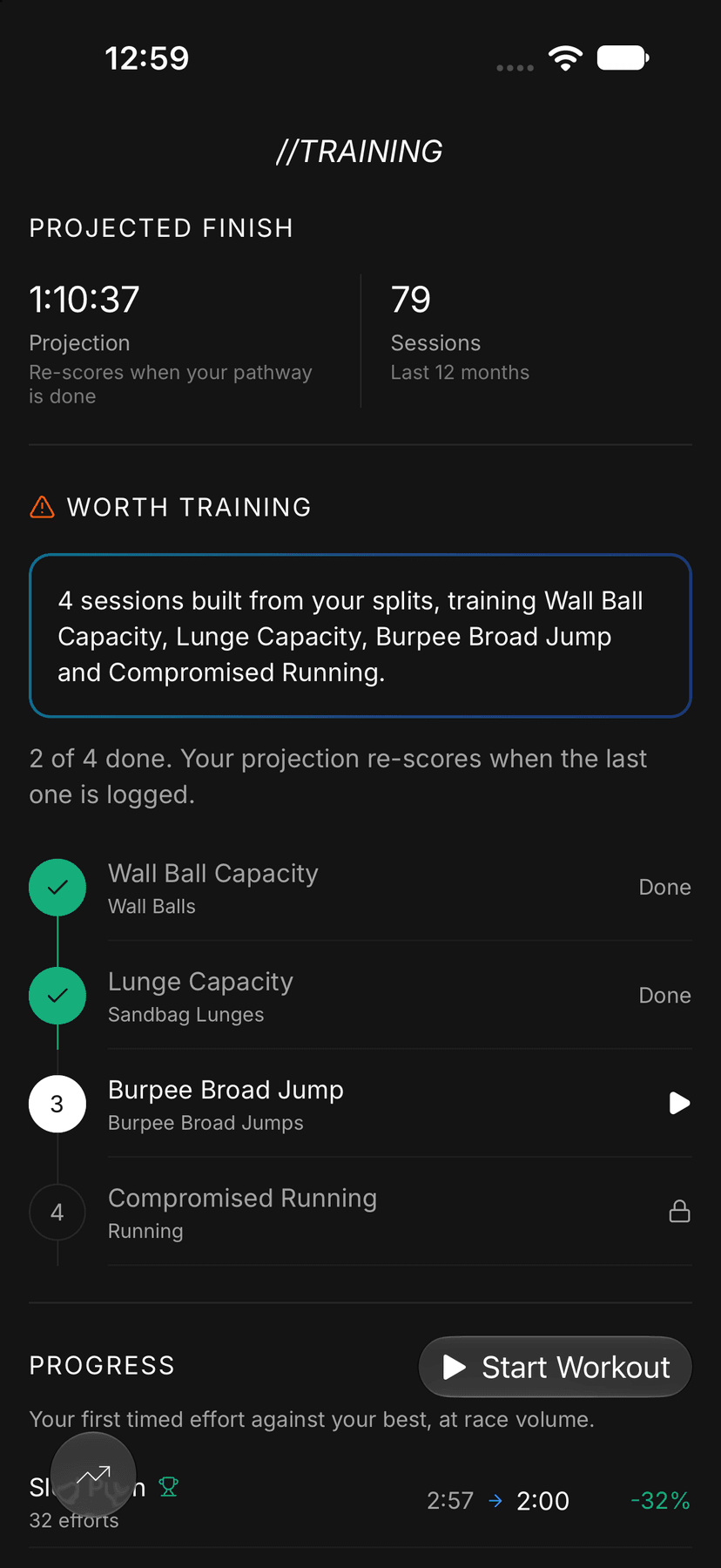
Three or four sessions aimed at the stations costing you most, generated around one focus each. The projection holds still until the block is done, so finishing it is what moves the number.
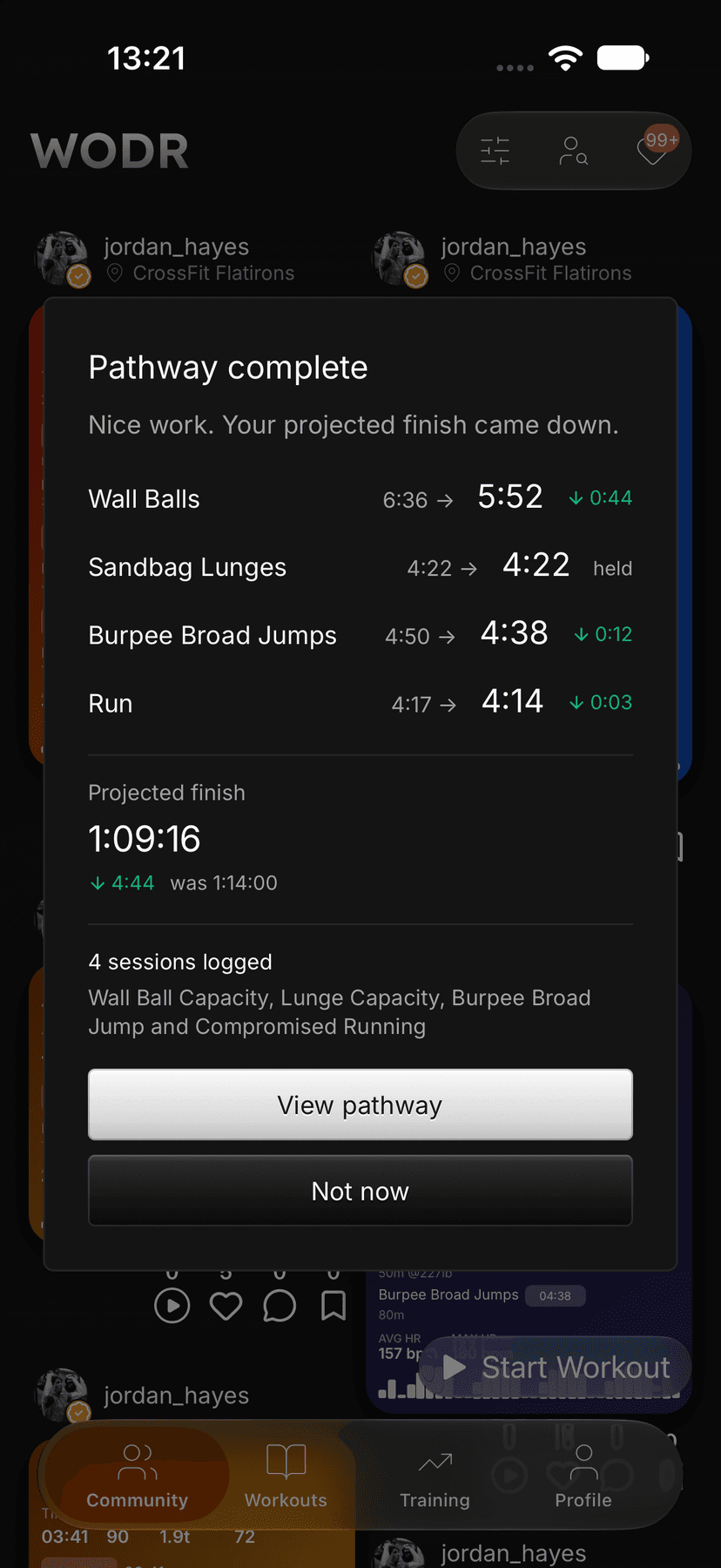
All eight stations, at race volume
Training focuses
Eight focuses,
each aimed at a limiter.
Each pathway session is generated around one of these, picked for whichever stations your projection says are costing you most.
Running
Compromised Running
Running on legs that have already worked. The first 100 m off a station is what this is really training.
Aerobic Base
Steady volume at a pace you can talk through. It is meant to feel easy, so resist making it a workout.
Stations
Sled Power
Heavy sled efforts with enough rest between them to keep moving it well. Quality counts for more than total metres.
Lunge Capacity
Lunges under load, then work on legs that have already done plenty. Short strides hold up better than long ones.
Wall Ball Capacity
The last station of the race, trained once you are tired. Pick a set size you can hold all the way through.
Burpee Broad Jump
Down, out and up again, over and over. Longer jumps mean fewer burpees, so reach.
Engine
Erg Power
Ski and row at a split you could hold eight times over. Not your best one.
Grip Endurance
Long carries and pulls, with time on the move in between. Let the hands hang on the easy sections and they recover.
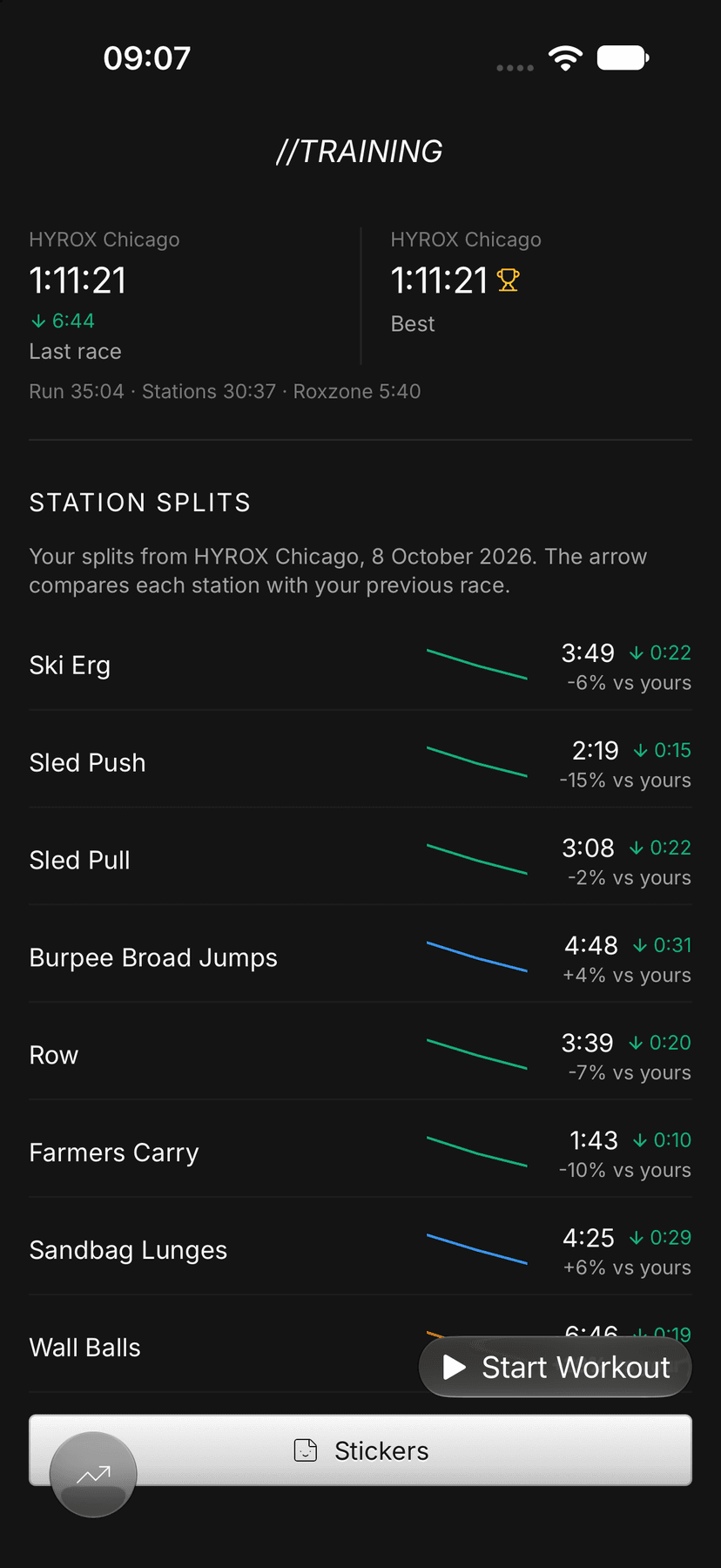
Every station against your last race, station by station
Questions
HYROX
questions.
- What does HYROX training in WODR actually do?
- You set a baseline by recording one measured effort per station at race volume. From that WODR projects a finish time across all eight station legs, the eight runs and the roxzone, then builds a pathway of three or four sessions aimed at whichever stations are costing you the most time. The projection holds still until you finish the block, so completing it is what moves the number.
- I do not have a sled or a ski erg. Can I still use it?
- Yes. WODR substitutes a station you cannot equip with the closest stand-in you can, matched on time rather than on reps, and carries a proportion of that effort across to the station it replaced. A loaded thruster counts for most of a wall ball; an unloaded jump squat counts for very little. A station with no workable stand-in is left in place and simply skipped rather than quietly dropped from the race.
Further reading
HYROX is one part of WODR. See everything else it trains.